
A deep dive into case studies that show how energy management reduces costs, emissions and operational risk for businesses.
Energy efficiency is often discussed within sustainability strategies, yet many organisations struggle to translate ambition into practical action.
In this paper, Energy Partners’ Ruhan Theunissen explores how traditional energy management practices, including energy audits, HVAC optimisation, lighting upgrades, power factor correction and behavioural change, continue to deliver some of the most immediate and measurable results for organisations.
Drawing on real project examples across sectors such as retail, education and industrial facilities, the paper demonstrates how relatively straightforward interventions can unlock substantial financial savings while simultaneously reducing carbon emissions.
At a time when electricity prices in South Africa are projected to continue rising sharply, energy management is no longer simply an environmental initiative. It is increasingly a core strategy for protecting operational resilience and long-term financial sustainability.
Executive overview
As sustainability becomes more central to corporate strategies, businesses face growing pressure to reduce carbon emissions and operate sustainably. Yet many fail to act meaningfully.
This paper argues that traditional energy management offers a powerful, underutilised solution.
While sustainability strategies often get lost in rhetoric or greenwashing, practical measures like energy audits, HVAC optimisation, power factor correction, and behavioural changes deliver immediate, measurable impact.
Using real-world case studies, the paper illustrates how such interventions not only reduce emissions but also generate substantial financial savings and improve long-term business viability.
With electricity prices in South Africa projected to rise sharply, energy cost control is no longer optional but critical to financial sustainability. By aligning energy efficiency with the triple bottom line of People, Planet, and Profit, organisations can achieve tangible progress towards their sustainability goals.
This paper positions energy management not just as an environmental responsibility, but as an essential strategy for business resilience and economic survival.
Introduction
In today’s rapidly evolving business landscape, the concept and terminologies of “sustainability” have become commonplace in our corporate vocabulary. This shift reflects a growing recognition that long-term value creation depends not only on financial performance but also on how responsibly a company operates within society and the environment.
Although profit and financial prosperity should still remain the primary goal of business, the wider influence and impact of businesses on society and the environment cannot be overlooked.
Investors, customers and governments alike are demanding transparency on carbon footprints, climate risks, and social impact. Sustainable development and Environmental, Social and Governance (ESG) disclosure are now setting a new form of “economic rules”, similar to how Black Economic Empowerment (BEE) has shaped business.
One of the defining metrics by which climate change impact is measured is carbon dioxide emissions in tonnes CO2 equivalent (tCO2e). Subsequently, many companies have announced “zero emissions” and “green” targets to strive towards. The United Nation Sustainable Development Goals (SDGs) also lay out 17 principles such as Affordable and Clean Energy and Climate Action and Responsible Consumption and Production.
Although these principles and ambitions are well-meaning, they can quickly end up as merely paying lip service to corporate jargon with no substantiation to actually “move the needle”, otherwise also known as greenwashing. A net-zero statement can easily be made but how is it practically going to be achieved?
The hype-cycle could also explain the rollercoaster ride that sustainability strategies often follow.
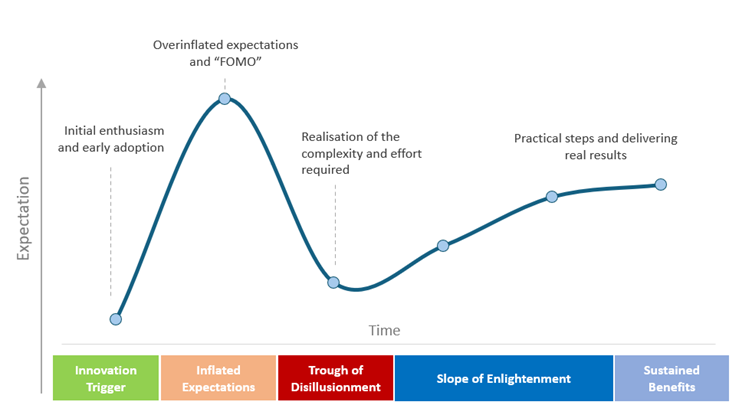
Initial enthusiasm around setting targets and ambitions is quickly followed by disillusionment when the complexity of real change sets in. The challenge lies in moving beyond the rhetoric and into action.
This is where energy efficiency emerges as a powerful and practical lever. While it may lack the glamour of futuristic green tech, traditional energy management remains one of the most immediate and cost-effective ways to reduce emissions. Frameworks like ISO 50001 provide a proven path to measurable impacts. Yet these proven solutions and guidelines are frequently overlooked in favour of more ambitious initiatives.
By reconnecting with the fundamentals of energy efficiency, businesses can cut through the noise and make real progress toward their sustainability goals. Within the broader ESG agenda, energy management is not just relevant… It’s essential.
Financial sustainability
The traditional view of sustainability was primarily from a financial context. Financial reports and business growth strategies often still refer to “sustainable profitability and business growth”. Before the climate debate entered the fray, energy management’s impact was measured mainly on its financial performance and impact on the bottom line.
The key elements of ESG can also be laid out according to the Triple Bottom Line concept of People–Planet–Profit. The overlap of these three components is a balanced approach that not only considers profit, but also the environmental and social stewardship that needs to go with it.
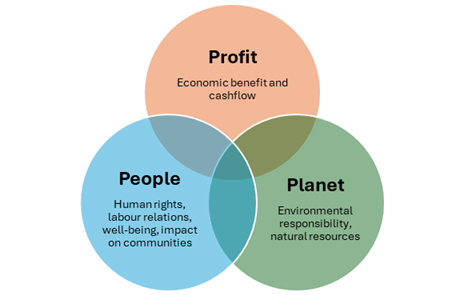
However, the profit leg of the triple bottom line cannot be ignored or overshadowed. Simply put, without profit there is no business and economic prosperity.
On an energy level, electricity cost is rising at above-inflationary rates for the past decade. The question businesses face is thus: “Can my business continue to absorb this and operate profitable in the long-term?”
The Profit in the People-Planet-Profit balance is therefore at risk. If the Profit leg of the table breaks, People falls with it. Simply put without business, there is no social prosperity.
Eskom’s approved increases for the next three years are 12.74%, 8.76% and 8.83% respectively. Thereafter, increases of around 10% are expected to remain the norm up to 2030.
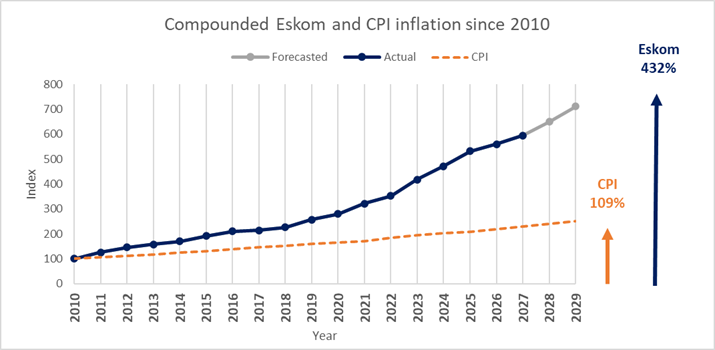
The compounding effect of electricity price increases will outpace inflation by nearly 4x by 2030 since 2010 based on this assumption.
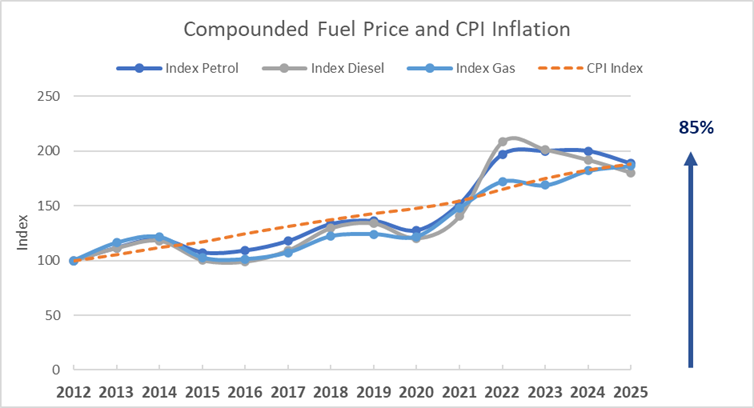
The same trend is happening with fuel prices:
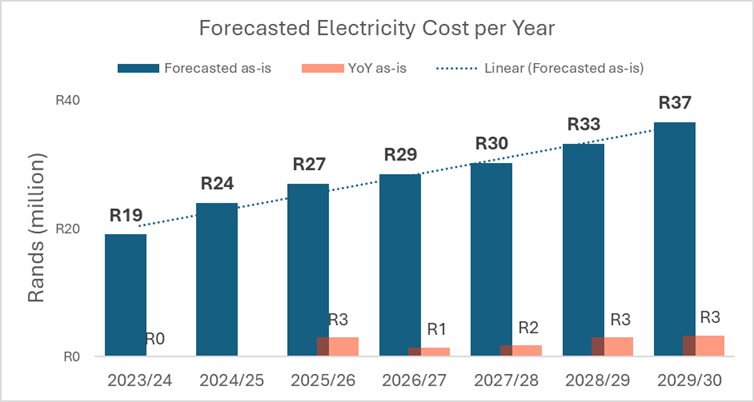
As a case study, a forecast was done using a typical medium-sized organisation’s electricity cost. The result showed that the organisation’s electricity costs are expected to nearly double by 2030 from a 2023/24 baseline if these anticipated increases are applied.
In 2024, the organisation’s electricity cost was R24 million per year. This will increase to R37 million per year by 2030.
The question arises: Is this at all sustainable from a business and financial perspective?
The conclusion is that energy, as an expenditure, poses a severe risk to the overall sustainability of businesses regardless the environmental impacts.
Examples of energy management at South African organisations
An energy manager’s worst fear should be that an energy audit turns up zero opportunities, implying a 10/10 score that a facility is running at its most efficient. Personally, every energy audit I have conducted has revealed an opportunity to save – be it small or large, an easy fix or one that is capex intensive.
The following examples showcase the typical opportunities that are still to be found through the application of energy management programmes or energy audits.
Water heating
Saving = R786k/year
A recent survey of a client’s energy use highlighted a significant water heating opportunity. Their hostel blocks still utilised conventional electrical resistance heating elements to produce domestic hot water (6 x 24kW systems). The system consumed around 519 000 kWh per year, costing the facility R1,12million per year.
Changing the setup to heat pumps could provide significant energy and cost savings.
Heat pumps use about a third of the energy of conventional elements to heat water, leading to a possible energy saving of 363 308 kWh per year, and an expected electricity cost saving of R786 890 per year. The payback on this project would be expected to be around 2.8 years.
The potential 18% saving on overall consumption showcases the significant impact energy management can have both financially and in terms of carbon footprint.
LED lighting
Saving = R1.8m/year
Given how inexpensive LED lighting has become, it’s hard to believe older fluorescent lighting is still so commonplace. In a survey recently completed on a client’s portfolio of 134 small retail sites, 46% of lighting was found to be T8 or T5 fluorescent tubes – 434 kW worth of lighting in total.
A typical 1.5m T8 fluorescent tube has a rating of 58W. The equivalent LED is 24W, giving it an energy saving of 59%.
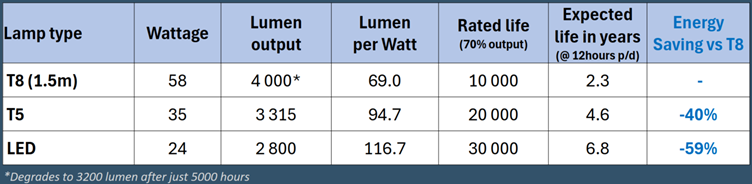
If the client opted to change the remaining T8 and T5 lamps to LEDs, an energy saving of 635 000 kWh would possible per year. This amounts to a cost saving of R 1.8 million per year, and the equivalent carbon footprint saving is 661 tCO2 pear year (that’s equal to about 343 tons of coal burned less by Eskom, based on latest value of 0.56 kg/kWh as stated in their annual integrated report).
The payback on this project is expected to be in the order of two years which makes absolute financial sense.
HVAC optimisation
Saving = R230k/year
An energy efficiency audit conducted at a large retail client showed that significant energy savings would be achievable by upgrading the control system and implementing an economiser air cycle.
The HVAC system still utilised the original designed “set and forget” control system with fixed dampers and temperature setpoints. This meant the system was unable to actively adjust the fresh air ratio to draw in cooler ambient air from outside when available to lower the mechanical cooling load on the chiller plant.
Retrofitting the existing air handling units with automated dampers and controls was recommended. Modelling of the HVAC energy use showed that an overall saving of 11% per year would be possible, peaking at approximately 30% in spring and autumn months.
The total estimated energy savings were estimated to be 134 640 kWh per year with a cost saving of R232 294 and a reduction in carbon footprint of about 140 tCO2e per year. The payback on recommended upgrades would be 2.6 years.
This opportunity illustrated that replacing an older system with a more modern one is not always necessary. Energy savings can also be achieved using existing hardware albeit with some minor upgrades.
Behavioural energy management
Saving = R67 500/year
An educational institution’s online electricity metering system tracked daily energy consumption. We noted excessive energy consumption in empty classrooms throughout the night, wjere air conditioning and heating were not turned off, a clear opportunity for improvement.
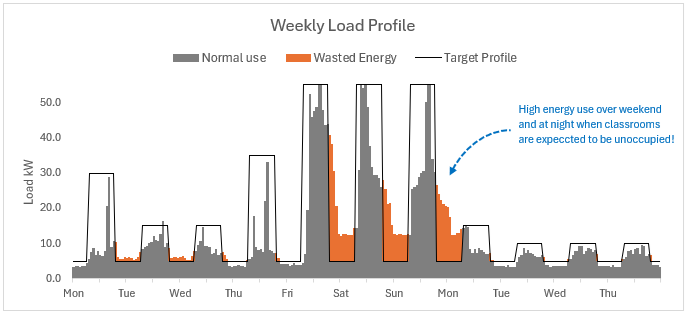
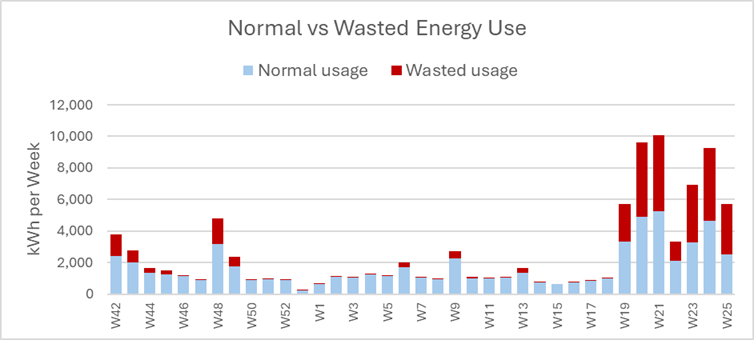
Over nine months, the wasted energy made up about 33% of the classroom’s total energy use. This is a significant amount of energy that could be reduced.
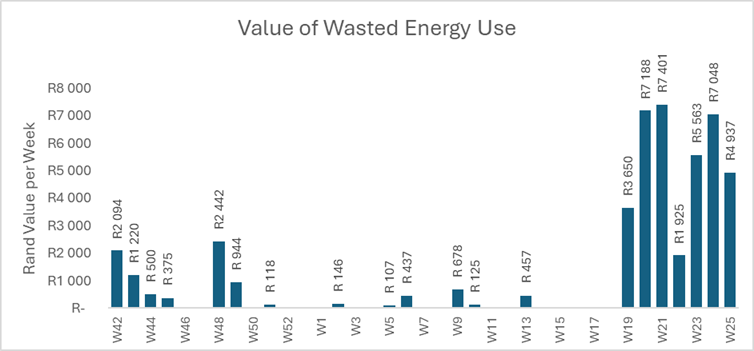
The value of this unnecessary energy use was valued at R48 000, which, when extrapolated over a full year, amounted to R 67 500.
This opportunity was addressed with a simple “switching off when not in use” policy. Alternatively, a few inexpensive timer switches could be deployed to cut power to AC units at night.
Power factor correction
Saving = R995 000/year – R1,2m/year
Power factor correction is an often-overlooked opportunity, partly because it’s not entirely understood, but mostly because it’s hidden in a DB room that not many visit to check if it’s still in working order.
Six power factor opportunities were recently identified in a client’s portfolio, with an expected total saving of R 995 000 per year. In total, about 340 KVA would be saved in maximum demand.
Similarly, a food processing plant has been able to achieve a saving of R1,2 million per year by fixing and upgrading its power factor correction. The average monthly KVA saving is 645 KVA.
Online utility metering and energy management uncovered these savings opportunities.
The payback on power factor correction projects is typically around 1-2 years in cases where demand tariffs are still high (demand tariffs upwards of R400/KVA is not uncommon as a result of continued tariff increases).
Between these two client examples, nearly one megawatt of demand was reduced, a significant amount of apparent power that frees up much-needed generation and network capacity on the grid.
The value and importance of energy management
These case studies prove the opportunities rife within traditional energy management, making a firm case for it as a key tactic that should be deployed for business resilience.
By Ruhan Theunissen, Energy Partners