
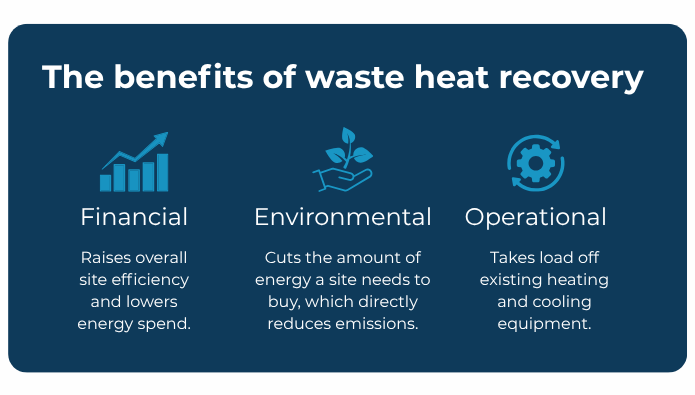
Industrial facilities often reject usable heat while purchasing fuel or electricity to meet heating requirements elsewhere. But recovering rejected heat can reduce energy costs, improve overall plant efficiency and lower carbon emissions.
Waste heat recovery (WHR) is becoming an increasingly attractive opportunity for energy-intensive businesses, particularly those with processes that require both heating and cooling. Older factories may have significant untapped potential, while newer facilities, even those designed with heat recovery systems, can benefit from further optimisation.
According to Philip van der Merwe, Head of Projects, Thermal at Energy Partners, identifying these opportunities requires a comprehensive assessment of energy use across the facility, rather than evaluating individual pieces of equipment in isolation.
This involves examining where energy enters the operation, how it’s used, and where recoverable heat is being rejected, whether from refrigeration systems, gas or diesel generators, industrial processes or flue gases. “The objective is to recover that heat and put it to productive use elsewhere in the facility, reducing the need to purchase additional energy,” he explains. “The savings can be directly measured through a reduction in fuel consumption.”
Where are the opportunities for waste heat recovery?
WHR is particularly relevant to industries where cooling and heating are both essential to production, including poultry and meat processing, dairies, cheese production, pharmaceuticals and beverage bottling. Ammonia refrigeration plants commonly used in these facilities present opportunities to recover heat that would otherwise be rejected to the atmosphere and use it to offset heating requirements elsewhere.
The strongest opportunities typically arise when:
- Existing plants have untapped heat sources that can be matched to heating requirements elsewhere in the facility.
- Facilities are undergoing upgrades or expansions, allowing heat recovery to be integrated into new or existing utility systems.
- Equipment is scheduled for replacement, creating an opportunity to incorporate heat recovery into the design.
- There is sufficient recoverable heat and a compatible heating demand to justify a standalone installation.
Depending on the application, WHR projects can achieve payback periods of less than two years, making a compelling financial case for recovering energy that would otherwise go unused. Heat recovery can also be incorporated into a Utility-as-a-Service model, allowing businesses to benefit from recovered heat without necessarily investing in or managing the equipment themselves.
“Waste heat can be metered and supplied as an additional benefit to an existing ammonia refrigeration plant, with Energy Partners incorporating this into its Cooling-as-a-Service (CaaS) model,” explains Derwalt Erasmus, Mechanical Engineer at Energy Partners.
WHR in practice: Sovereign
At Sovereign’s chicken processing facility, Energy Partners’ CaaS refrigeration plant incorporates a waste heat recovery system that captures heat from the refrigeration compressors’ oil coolers. Instead of rejecting this heat to the atmosphere, the system recovers it for use in the factory’s production processes, displacing heat previously supplied by a coal-fired boiler.
Because the facility’s heating demand varies throughout the day, the recovered heat is stored in a large thermal storage tank. It can then be drawn off in substantial volumes during the facility’s daily draw-down cycle.
As part of the CaaS arrangement, Energy Partners manages the recovered heat as an integrated utility service, supplying Sovereign with approximately 50,000 to 120,000 kWh of recovered thermal energy per month.
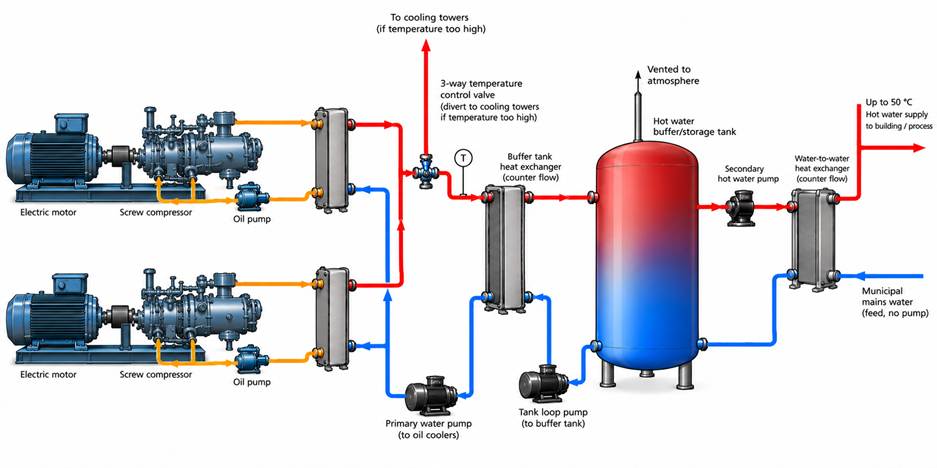
Energy Partners’ Cooling-as-a-Service (CaaS) refrigeration plant at Sovereign recovers waste heat from the refrigeration compressors’ oil coolers, displacing heat previously supplied by a coal-fired boiler. The recovered heat is stored in a large thermal storage tank and released to meet the chicken processing facility’s peak heating demands during its daily draw-down cycle. Managed by Energy Partners as part of its CaaS utility service, the system supplies Sovereign with approximately 50,000–120,000 kWh of recovered thermal energy per month.
Measuring and verifying the savings
The value of waste heat recovery depends not only on the energy recovered, but also on the ability to measure its contribution to reducing purchased energy. Energy Partners uses its Syntiro platform to monitor energy performance, utility expenditure and associated emissions data, providing visibility into the performance of its utility assets.
By measuring recovered heat alongside the facility’s energy consumption, businesses can quantify the contribution of WHR to operational savings and verify its ongoing performance.
How much usable heat is your facility throwing away?
Your existing plant could be holding an untapped opportunity to reduce energy costs. Energy Partners can help you identify where heat is being wasted, assess its recovery potential and build the business case for putting it to work.
Talk to our Thermal team about your waste heat recovery opportunities. Contact Philip van der Merwe at +27 84 723 1613 philipvdm@energypartners.co.za